


 27 April 2026
 Gambling News
Online Gambling Blamed for Sharp Rise in Personal Bankruptcy Filings
Are more people declaring for personal bankruptcy as a result of online gambling? Financial advisors and attorneys report a sharp rise in debt.
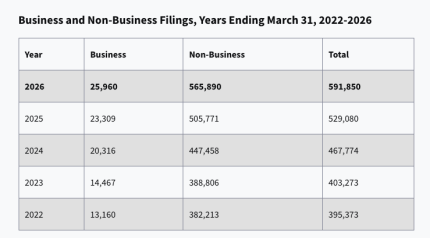
Non-business bankruptcy filings in the 2026 fiscal year, which concluded on March 31, 2026, increased 11.9% year over year to 565,890, according to a report released last week by the US government. Personal bankruptcy filings are at their highest level since 2019.
Some claim that the growth of online sports betting and the more recent appearance of contentious sports prediction markets are contributing to the dire financial outcomes.
Young males are particularly prone to developing gambling issues, which is costing them dearly, according to numerous studies.
“The debt builds incredibly fast because people aren’t gambling with cash; they’re gambling with borrowed money,” Chad Van Horn, a bankruptcy attorney in Florida, told Business Insider.
Van Horn said he’s seen credit card statements go from zero to $25,000 in “a matter of months.”
“The gambling is really the one that has really taken off,” added Ed Boltz, a bankruptcy attorney in North Carolina. “We’ve started to see people with $20,000, $30,000, $40,000 of fairly rapid credit card debt that they’ve incurred.”
In bankruptcy, are gambling debts forgiven?
Chapter 7 and Chapter 13 are the most common types of personal bankruptcy petitions. The federal legal procedure allowing a person to start over by discharging, restructuring, or getting rid of obligations under court supervision is a personal bankruptcy petition (Chapter 13).
Chapter 7 liquidates one's remaining assets and acts as a last resort against creditors and collection activities.
Gambling debts are typically forgiven in a personal bankruptcy, just like credit card and other personal debt.
"In a Chapter 7 case, the debt would be dischargeable. In a Chapter 13 case, gambling debts would be included in the payment plan with any remaining balance discharged at the end of the plan,” explained David Stevens, a New Jersey bankruptcy attorney with Scura, Wigfield, Heyer, Stevens & Cammarota, LLP.
“Gambling activity can raise red flags for the trustee, however. Recent or excessive gambling is especially a cause for concern to the trustee. This can lead to additional scrutiny from the trustee and objections from the creditors,” Stevens added.
Research on Gambling
According to a survey conducted last year by US News & World Report, one in four sports gamblers have neglected to pay their bills as a result of their wagers. Nearly one-third (30%) of sports gamblers acknowledged having debts related to gambling, according to the survey.
Of the sports bettors surveyed, more than half (52%) reported carrying a credit card balance on a monthly basis. Additionally, 25% acknowledged that they worried about losing control with their betting.
Last year, commercial sportsbooks received around $17 billion from wagerers out of a total of $167 billion.

 30 August 2026